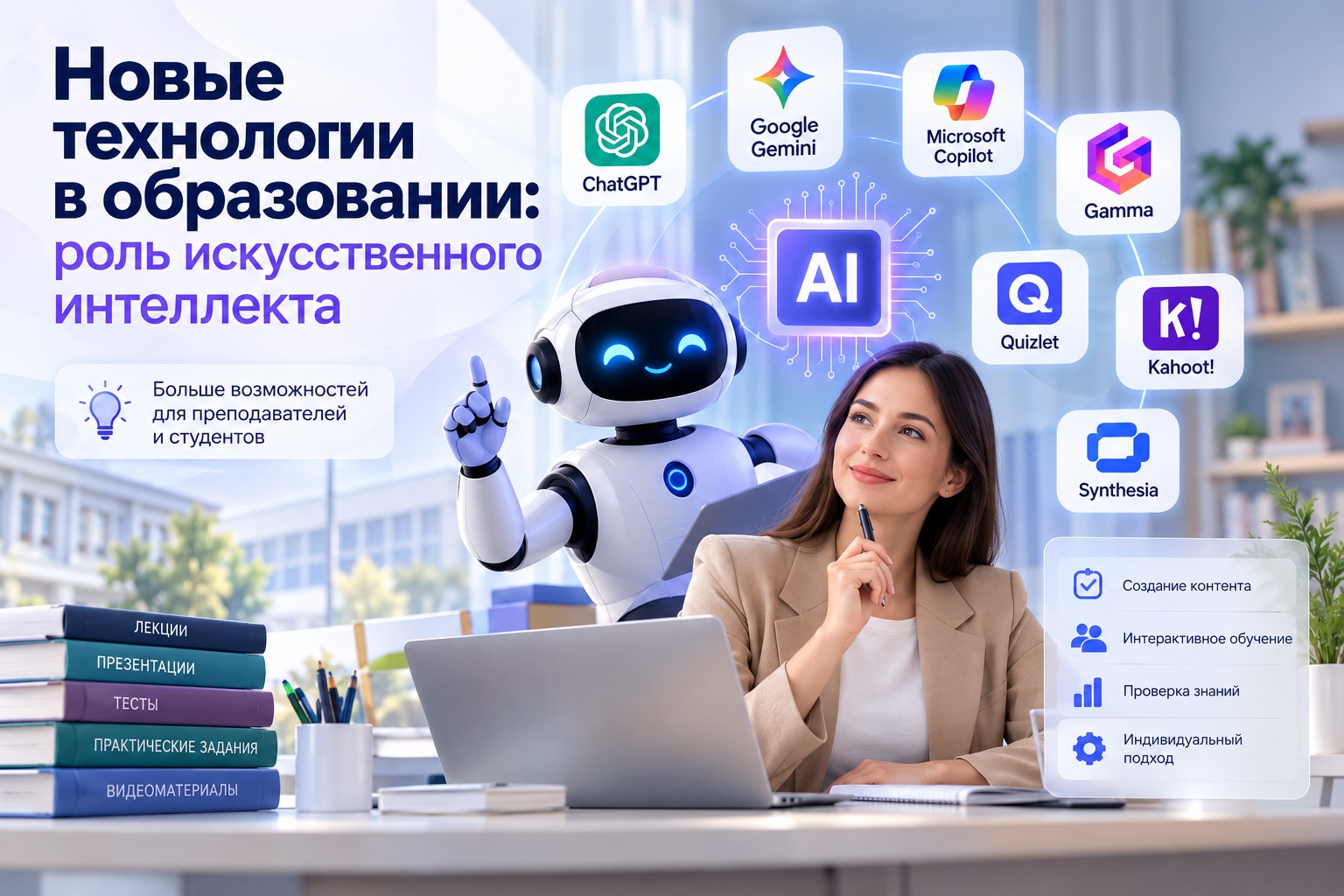
Artificial intelligence is becoming one of the tools for the development of modern education, opening up new opportunities for both teachers and students. Today, AI technologies allow not only to automate individual tasks, but also to organize the learning process in a new way, making it more interactive, flexible and focused on individual educational needs.
The use of AI in higher education is of particular importance. The teacher can use intelligent tools to develop lectures, practical assignments, tests, situational tasks, presentations, and digital learning materials. Students, in turn, receive additional opportunities to study complex topics independently, prepare for classes, and test their own knowledge.
What artificial intelligence tools can be used in the educational process?
ChatGPT helps to structure learning materials, develop assignments of varying complexity, form discussion questions, and model practical situations. The Study Mode allows the student to consistently understand the topic through questions, hints and explanations, rather than just getting a ready answer.
Google Gemini can be used to analyze and organize information, explain complex concepts, prepare educational materials, and organize independent work.
Microsoft Copilot helps teachers create lesson plans, test assignments, assessment criteria, and adapt learning materials to different levels of student training. Some educational features are available with the appropriate Microsoft 365 license.
Gamma is a tool for creating presentations and visually structured educational materials. Allows you to convert a lecture plan or a finished text into a visual presentation.
Quizlet — and Kahoot! — platforms for interactive learning, repeating terms, conducting quizzes and testing knowledge. Their capabilities, including AI-enabled functions, help to diversify the forms of educational work.
Synthesis — allows you to create educational videos with virtual presenters and dubbing, which can be useful when preparing video lectures and short explanations of educational topics.
However, the introduction of artificial intelligence requires not only technical training, but also the formation of a new culture of its use.
AI is able to generate convincingly formulated, but actually erroneous information. Therefore, the verification of information, the observance of academic integrity, the protection of personal data and the development of critical thinking are of particular importance.
An important area is becoming the formation of AI literacy – the ability to correctly formulate queries, evaluate the reliability of the results obtained, understand the limitations of technology and responsibly apply them in educational and professional activities.
For a teacher, artificial intelligence should become a tool for expanding pedagogical opportunities, and for a student, it should be a means of deepening knowledge rather than replacing independent thinking.
The future of education is determined not by the number of digital services used, but by how effectively they help people learn, explore, analyze, and create new knowledge.
Artificial intelligence is not a substitute for teaching. It changes the teaching tools, increasing the importance of a teacher’s professional experience, methodological competence, and the ability to form independent, critical, and creative thinking among students.